
Soapbox #7
Redefining “the perfect lawn.”
On the morning I wrote this Soapbox, I looked out my window and saw two different lawn company trucks parked side-by-side, spraying lawn chemicals at two different houses. One of those trucks was on its second lawn on my street. Shortly after those two trucks left, another truck pulled up to spray another lawn. Earlier that morning, when I dropped my kids off at school, yet another lawn company was there, gearing up to spray the entire premises of the school and adjacent church.
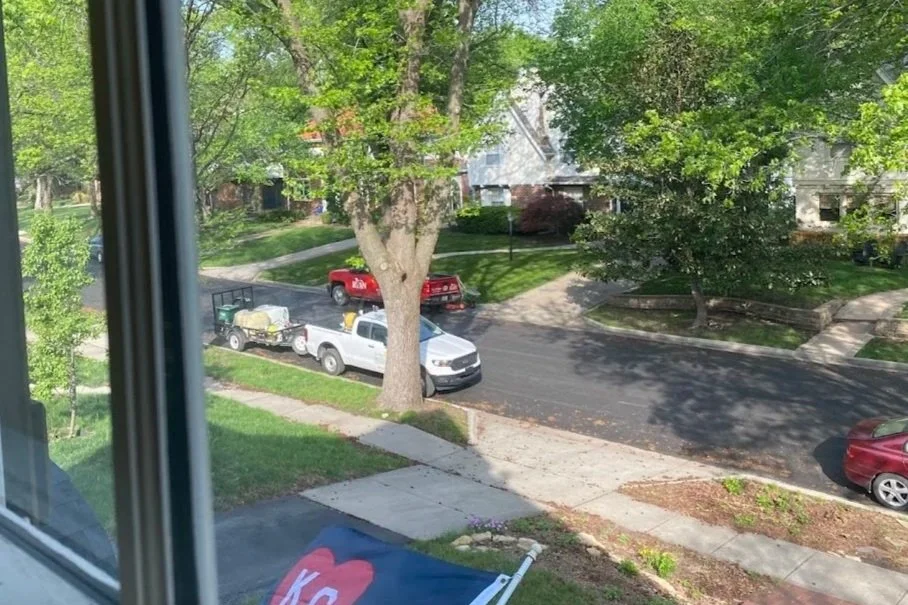
Side-by-side lawn company trucks spraying lawn chemicals on my street.
That is a LOT of chemical exposure in one morning, all in an endless quest for “the perfect lawn.” I submit that the problem—and solution—is rooted in our definition of “perfection.”
If your current picture of perfection is a homogenous, bright green, weed-free expanse, consider what that aesthetic necessitates: lawn chemicals—namely, pesticides, herbicides and synthetic fertilizers. (And, if you live in the Midwest, lots of supplemental water.)
Those lawn chemicals contaminate the air we breathe, the soil we touch, and the water we drink. In fact, if you live in Kansas City, those lawn chemicals are washed directly into the river, which supplies our drinking water. (As an aside, after I bought a water filter for our home, I did water testing to verify the filter was performing as advertised, and I happened to test our water before and after a big storm. The impact of storm water runoff on our water quality is shocking.)
When we pair our perception of lawn aesthetic with an awareness of the cultural practices required to produce that aesthetic, a homogenous, bright green, weed-free expanse suddenly seems less “perfect.” We recognize it as unnatural, and it gets our spidey senses tingling. By contrast, what used to be an “imperfect lawn”—one that’s a little patchy, with dandelions and wild violets throughout—becomes a lot more attractive, like a safe haven. We can plop down, lean back on our hands, take a deep breath, and relax.
Put somewhat differently, when the choice is simply “green grass” vs. “not green grass,” a lot of us will choose “green grass.” When the choice is “the greenness of our grass” vs. “the health of our families,” the greenness of our grass feels fairly trivial.
Many of us view our front yards as a way of showing pride in our homes and our neighborhoods. That pride is a good thing. It need not be incompatible with the health of our families and our earth. How can we show that our “imperfect-by-old-standards” lawns are a product of intentionality, rather than neglect? Use a yard sign. Talk to your neighbors about it. Replace a little section of your lawn with native plants, which thrive without chemicals or supplemental water (native plants can even filter chemicals out of our air, soil, and water, which is pretty incredible!).
We can flip lawn culture on its head. It starts with our definition of “the perfect lawn.”
